You’ll know by now that I’ve been learning Spanish for quite some time. I recently went on holiday to Mallorca and could generally understand what was being said between the locals and the people I was with, who were all fluent in the language.
Could I respond confidently? Nope. I think the most advanced thing that I said was ‘Hola, buenas, da me unos salsas, por favor.’ Which, by the way, wasn’t bad, and is way more than what I used to be able to say, but I’m still not as conversational as I’d like to be.
However, with my upcoming trip to Japan, I’ve pumped the breaks on learning Spanish and have shifted gears. I’ve got access to Super Duolingo, which I still think is worth the money, and have swapped to learning Japanese. It’s hard work but, like with Spanish, I’ve combined it with a couple of other methods – like using the app Lingopie – to ensure that it all sinks in.
Japanese isn’t easy, and I won’t be fluent by the time I go, but here’s the 4-step approach that I’m taking to learn some key words and phrases.

Method 1: Super Duolingo
Yes, Super Duolingo is still worth paying for. Yes, getting a 600-day streak was worth the hassle. At the time of writing, I’ve got to a 1343-day streak, and I’m still loving the gamified nature of the app.
But Japanese on Duolingo is a different kettle of fish.
I’m still early-on in the language-learning process with Duolingo, so am yet to fully explore what Japanese entails, but it’s pretty surprising how different it already is. With Spanish, I like to complete a healthy number of speaking exercises as well as the mini-games, such as Match Madness and the XP ramp-up challenge. These games satisfy the itch that I have to earn as much XP as possible (yes, I am a sucker for gamified experiences), but they’re also a great way to mix up the learning process so that it still feels fresh.
So far, I’ve not unlocked any of this on Japanese. I’m sure that this will become available with the more practice I complete, but Japanese on Duolingo is taking me on baby steps, which I really appreciate. For one, I didn’t realise that I’d be learning about three different systems of characters, like Hiragana and Katakana. Being a beginner, I presumed that it was all Kanji, and that it was it.
On that note, Duolingo will often slow me down and ask me to complete some writing practice of Hiragana before I’m allowed to complete any more standard lessons. The app will get you to do this throughout the learning process, again and again. As a teacher, I love this use of spaced repetition, since it’s an evidence-based method of learning that’s one of the most effective.
The current challenge that I’m on is asking for me to complete 5 practice rounds of Hiragana before moving on, which is great, too, since it’s not going to overwhelm me with too much at once. As a result, I’ll be more likely to come back to the app tomorrow to continue practising.
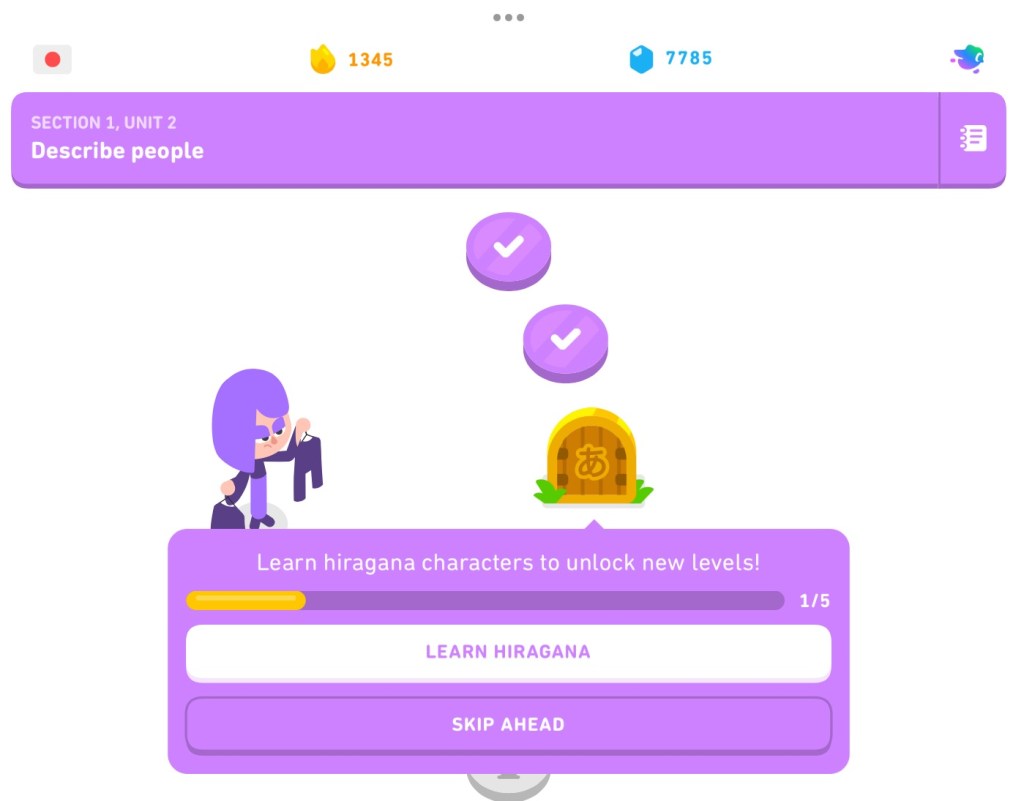
Don’t get me wrong: Duolingo hasn’t given me the ability to speak fluently with another Japanese person, but it is introducing me to some basic words and concepts that, at this stage, will help me to communicate some pleasantries, or ask for help if I need it.
Plus, I think it’s just basic manners trying to learn a little bit of the language of the country that you’re visiting.
Super Duolingo offer a variety of packages, starting at £4.99/month, or £89.99/year for the family plan. This gives you space for 6 people so, split between your whole family (or friendship group), you’d be looking at £14.99 each, or £1.20/month – a huge saving on the individual plan.
Sadly, Duolingo are yet to offer me an affiliate link – but when they do, you’ll be the first to know, so that you can save money on language-learning.
Method 2: Lingopie
I’ve spoken about the benefits of Lingopie before, when I used it for Spanish, but it’s just as good for my Japanese-learning.
The website, which also has an app, offers a service that’s a little like Netflix for language-learners. Lingopie has so much content available for viewing on its app and dual-subtitles them. The show that I’ve been watching is in Japanese, but you can follow along in both English and Japanese. While it’s on, I can also click on any words that I feel less confident on and add them to a bank of flash cards, which I’ll get tested on at the end of each episode.

Just from looking at the screenshot that I’ve included above, you might think that this is pointless. If I’m not a master of the language’s system of different characters, like Kanji, what could I possibly get out of it?
Well, another method of learning that I really enjoy is learning through over-exposure. Simply listening to Japanese is exposing my brain to another language. Doing this repeatedly will mean that my brain might start to recognise the new sounds and symbols that are being used.
I did the exact same when I was at school: when I completed my daily paper round, I listened to a voice recording of myself speaking through all of my notes. I did this every day in the run-up to my exams, and it really moved the wheel with helping me to memorise what I needed to know.
Usually, Lingopie goes for $5.99/month if you opt for a yearly plan, $12/month for 3-months, and $199 for a lifetime subscription, which I think is the best value for money. If you want to use their live tutoring programme, which gives you 1-2-1 or group sessions with a tutor via video call, you’ll have to pay extra. Or, why not try it for free for 7 days instead? I’m hoping to do a run-through of my watch list soon.
Method 3: Anime
Seriously.
Watch anime.
Anime is such a great format for content that so many people sadly pre-judge as being just for children. If you’re into House of the Dragon, and want a recommendation that disproves the childishness of anime instantly, then I’d strongly recommend Attack on Titan. If you’ve ever read or watched Dragon Ball, then you’re into Shonen, or action-based anime; so go for Demon Slayer or Jujutsu Kaisen. They’re both fast-paced, violent, and have huge stakes.
For a more comedic anime, which still has a lot of action, try out One Punch Man.
But if you’re still in doubt, have a think: have you ever watched something like X-Men ‘97 or Marvel’s What If…? If the answer’s yes, then you’ll probably enjoy anime. It’s just Japan’s answer to American cartoons, and the genres range from stupid and silly to serious and heart-pounding drama.
While you’re watching, be sure to select English subtitles, so that you can understand what’s going on while listening to the Japanese dub. Just like with Lingopie, you’ll slowly absorb what’s being said. This method will be less involved than Lingopie or Duolingo, but over-exposure is never a bad thing when it comes to learning a new language.

I currently use Crunchyroll for my anime fix, which is £4.99/month, or £5.99/month (£59.99/year) for the more expensive tier.
Method 4: Write everything down
Last year, I completed a Master’s in Teaching Studies to investigate whether students made more progress in History while using a digital exercise book, or while using a standard pen and paper combination.
The results were pretty inconclusive.
However, some of the research that I discovered did suggest that people can make more progress when they’re using a pen to write things down – whether that’s in an exercise book or on a digital display.
I think you know where this is going.
Whenever you finish your daily Japanese learning, start writing everything down. Whenever I can, I like to record what I’ve learned in a notebook on OneNote. OneNote is great for many reasons, and I once even tried to use it as a digital Bullet Journal, but by using a digital platform, I’m keeping all of my language notes in one place.
How you organise your Japanese notebook is up to you. You might want to simply write down everything you remember; you might want to separate your new words into verbs, nouns, etc.; you might want to make a specific space for Kanji and Hiragana. Or you might have a totally different way of organising your notes book. Either way, writing things down has been shown to help with recall – so get started today.
Have you tried learning Japanese? Any tips for someone who’s never been there before? Did you need to pick up any words or phrases, or did you do just fine with your native language?
If you liked that, you’ll love…
 Hardly Hamilton
I would love to learn Japanese. I visited Tokyo and Kyoto in 2016. And I would like to go back to spend a few months in this beautiful country. I love it.
LikeLiked by 1 person
How lucky! Do you have any recommendations for either Tokyo or Kyoto?
LikeLike
To tell you the truth. We did a lot of things. Everything was planned in advance. In Tokyo I stayed in the perfectura, UENO area. Senjukawaracho. We took the subway to go to the center. But it was a very quiet neighborhood. There are many airbnb. We also ran the Mount Fuji marathon 🙂 . In Kyoto we met with the Vespa Club Kyoto, had coffee and went for a ride on the club’s Vespas. Amazing. Regards. Miguel
LikeLike