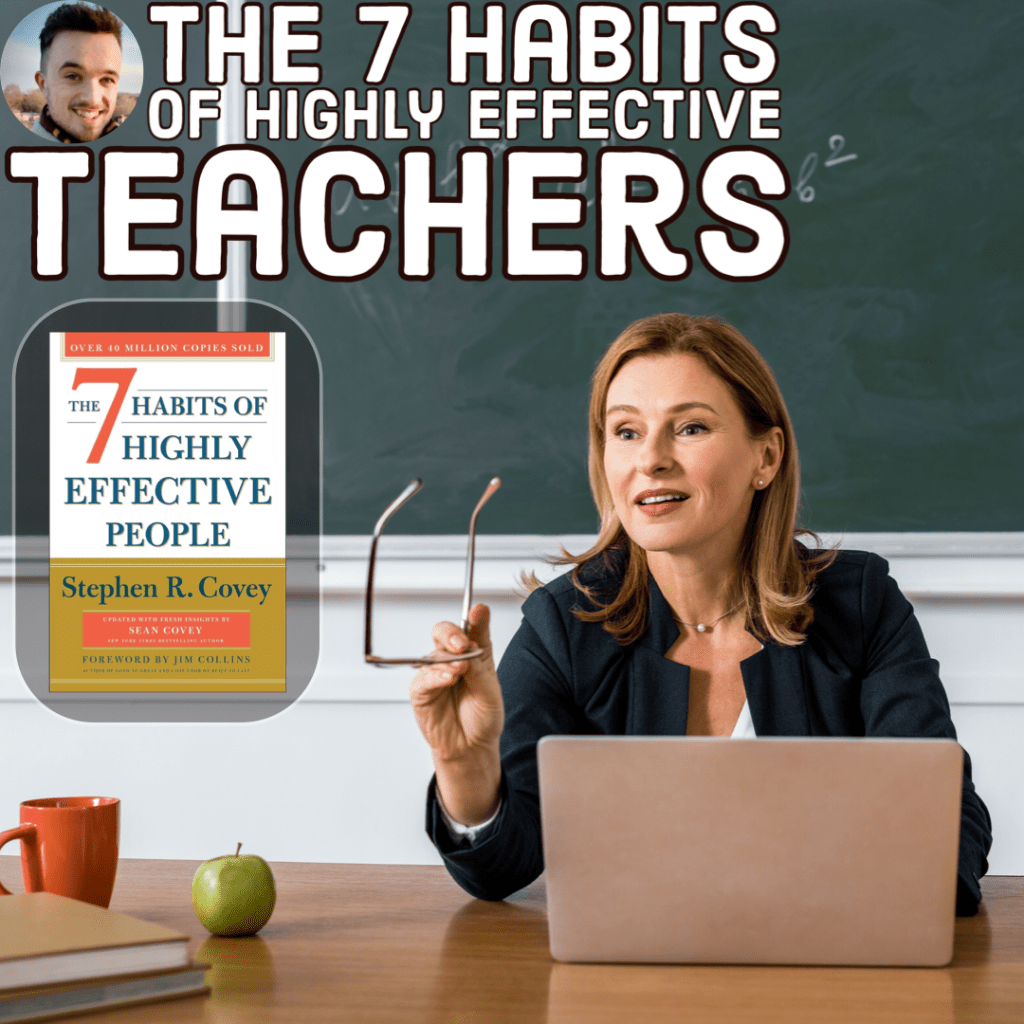
Not so long ago, I finished reading the 7 habits of highly effective people. Stephen Covey published this in 1989 and it’s been revisited time and again. The copy that I listened to on Spotify had been updated with personal insights by his son, Sean Covey. Having that extra commentary on the original 7 habits helped me to actively reflect as I was reading, and I actually think that a redone version, released thirty years later, indicates a simple truth:
The 7 habits of highly effective people continues to inspire and shape the lives of millions. (paid link).
Nearly every productivity influencer, whether they’re a writer, blogger, or YouTuber, has felt the effects of this seminal book in one way or another.
I am no exception.
As I was reading, I was thinking about how I could apply these habits to my own life. From a productivity point of view, they have a huge impact – and I will probably cover that in due time. However, what I really took away from this text was how I could apply these principles to my teaching profession.
What are the 7 habits of highly effective teachers?
Habit 1: Be proactive
Take control of your life and focus on what you can influence, rather than reacting to external factors. In teaching, you won’t be able to control everything and will often need to enforce things out of your control. So, narrow your focus to what you’re in control of. Stay on top of your form group, your teaching groups and when and where you choose to do your work.
If you can’t influence it, put your focus elsewhere.
Habit 2: Begin with the end in mind
This one comes back to good, clear, planning. If you teach day-by-day, without the end in mind, you’ll be drifting aimlessly between PowerPoint slides and Word Documents. Before you know it, your classes will be well behind everyone else’s and fully unprepared for impending exams or assessments.
If your department doesn’t already have it, get started with making a medium and long-term plan. You’ll know what you’re teaching today, what you’re teaching tomorrow, and what you’ll be covering a month from now. That way, if you start to fall behind, you’ll know how much to catch up on.
Habit 3: Put first things first
Covey has this great importance-versus-urgency matrix, which essentially allows you to assess if a task if urgent, important, urgent and important, or neither. As teachers, we need to learn to put first things first by prioritising important tasks, rather than urgent ones.
I’ll give you a real example: the other day, I needed to set students their homework on Google Classroom. I had to do it on Thursday to give them enough time to complete it before the next lesson, making it an urgent task.
However, I’d also sent a student to our isolation room due to poor behaviour. We’re expected to have a restorative conversation to restore the relationship prior to the following lesson – and to call home to make their parent aware. Personally, I think that people are the most valued parts of any organisation, so this task was urgent and important. I ensured that I spoke to the student first and set homework the following day.
Not only does following this approach help you to remain focused on what really matters, it also prevents you from overworking yourself, which can so easily be done in this very busy career.
Habit 4: Think win-win
Don’t go into situations trying to just get the best for yourself, to the detriment of others. It shouldn’t be a case of you winning and others losing. It should be a case of trying to make sure that everyone wins. Covey suggests that insisting that you get your way, and only your way, is counter-productive; it’s going to sully your relationships and often lead to lack of resolution. By going for win-win, you’re both going to feel happy about the outcome.
In teaching, adopt this mindset when interacting with colleagues, especially from the perspective of a line manager. How can the needs and interests of both parties be satisfied? The same rule applies to interacting with students: how can you both come out of a situation having won? If you want a student to be quiet when you’re addressing the whole class, what could you do for them? Could you move them elsewhere in the seating plan? Could you catch them being good and award credits?
The possibilities from thinking win-win are endless.
Habit 5: Seek first to understand, then to be understood
This, for me, was the biggest lesson that I took away from Covey’s book. This habit is about practising empathy. When you’re talking to a student, listen to them.
No, but, actually listen to them. Truly try and fully comprehend others’ perspectives before expressing your own. By showing genuine interest and respect for somebody else’s viewpoints, you’ll build trust.
Still not sold? Look at it from the other perspective: you could go in, all guns blazing, holding your view very close to your chest and shutting down the other without giving them a chance to speak. It’s so easy to adopt this way of speaking when you’re getting frustrated in the moment, but it’s important to actively practice understanding alternative viewpoints for a few reasons:
- It shows that you care.
- It helps you to think differently. Maybe there was a part of the situation that you missed, and that’ll help you to reassess your approach if necessary.
Following this habit will do wonders for your behaviour management.
Habit 6: Synergise
Let’s face it: nobody’s perfect. We all have our own strengths and weaknesses that will either build us up or tear us down. In any profession, you need to leverage the talents of you and your colleagues to work together – or synergise – and support each other. You’ll be combining your own talents with others’ to come to the best solutions that benefit everyone involved.
In teaching, synergy is critical. I love digital technology, so it makes sense that I take on all of the digital tasks, whether that involves training colleagues, making screencast tutorials or trialling new strategies, and reporting back to Team History. Meanwhile, the Head of History might be great at restorative conversations, so it would make sense to bring them along if I’ve had to place any students into the isolation room.
Know your strengths, know the strengths of others, and help each other out.
Habit 7: Sharpen the saw
This is my favourite habit. Covey tells the tale of George Washington being given a saw to cut down a tree in 6 hours. He said that he’d spend the first 4 hours sharpening the saw.
Why is this relevant?
The moral of the story is that you need to spend time working on yourself before you can work on anything else. In teaching, this is simple: don’t teach all day.
Obviously you need to teach your timetabled hours; that goes without saying. Do the very best possible job that you can in however many hours of teaching you have that day. But when that final bell rings, you need to set yourself a time to clock off. Clock off and do something that you enjoy.
For me, it’s going to the gym or bouldering. For you, it could be playing video games or sitting still with a good book.
Whatever it is, you need to take time for you and recharge. Work takes up a lot of our life, but is is not all of our life. Take time to sharpen the saw and the other habits will come easily.
Have you ever read the 7 habits of highly effective people? What did you learn from it? Let me know in the comments below. If you’ve not read it, what are you waiting for? Get yours here (paid link).
If you liked that, you’ll love…
- How to run a calm, high-impact registration: setting the tone in the 15 first minutes of the new term.
- How video games made me a more productive teacher
- How to build a sustainable reading habit in just ten pages a day
- How to stop your to-do list overwhelming your brain
- How to Clean up your Second Brain: a Guide to Digital De-hoarding
Follow my socials everywhere:


I appreciate your perspective on applying the 7 habits to teaching. I have some additional suggestions to make as you talk about making empathic connections with your students. I feel this extends very well into the following habit of synergy and the preceding idea of win-win.
I agree that synergy (and thinking win-win) with our teaching staff is valuable and important, but what about synergy within the classroom? Our students are often coming from different paradigms and perspectives, perspectives that will ultimately contribute more to their education than our own. Can I, as a teacher, develop these habits and empathic communication such that it allows me to synergize with my students and find more win-win solutions? Can we, as a classroom, do it in a way that allows the class entity to be proactive, begin with the end in mind, and put first things first?
I like to think of the classroom much in the same way Covey presents different companies throughout the book. What could the class accomplish/learn if we collectively:
1. Be proactive – identify that we have control over our education and what we learn
2. Begin with the end in mind – Identify the classroom goals and purposes and what’s important to us – write a class mission statement
3. Put First things First – prioritize the learning and methods that are important to us instead of filling our time and class with busy work or unproductive activities
4. Think Win-Win – Can their goals to learn and have fun, and mine and the school’s/parent’s goals of a good education be accomplished together?
5. Empathic Communication – as you addressed very well, can we communicate in ways that connect us and truly listen to each other
6. Synergy – As a collective classroom we can accomplish more than if we just did things my way or left them alone to do it all their own way
I am learning that the student’s educational perspective/paradigms (particularly in the upper grades) have more influence on their learning than anyone else’s. What can we, as teachers, do to incorporate their paradigms into our teaching? I believe that including them in the teaching process will empower them in the learning process and result in far better outcomes.
LikeLike