When you’re Head of Department in a secondary school, you have a lot on your plate. Suddenly, you’re not only delivering lessons, but also keeping your team updated, managing their performances and ensuring that the curriculum gets delivered.
It’s a lot of work, but somebody’s got to do it.
I love getting to leave my mark on how History looks at my school. Your school might use a curriculum that’s been co-planned with another school in your trust, or you might be going it alone. Either way, it’s important that you ensure your team delivers what you’d expect to see in their classroom – and that you have those fierce conversations if they’re not.
After all, you’re not doing this to serve any egos; you’re doing this job for the kids, and don’t they deserve the best?
I’ve got three levels that I use to keep my Team on-track as Head of History.
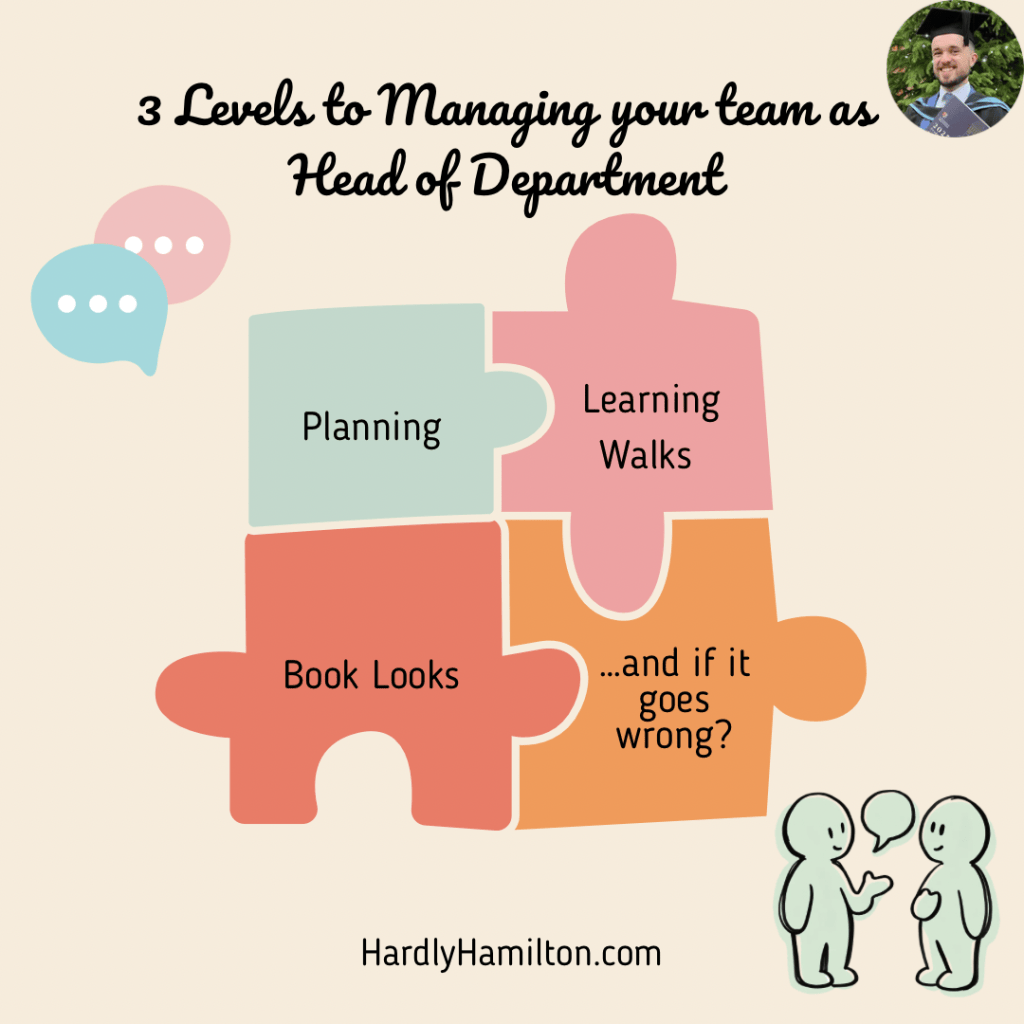
Level 1: Expert planning
Before I’ve even discussed expectations with my team, it’s important that I’ve got a decent Long Term Plan.
While our Key Stage 3 LTP was co-planned alongside other schools in our Trust, the KS4 and KS5 LTP is of my own design. As a result, I need to ensure that it’s robust. There are three questions that I ask to do this:
- Do we have enough time for content?
- Do we have enough exam skills practice?
- Is there ample time for teacher marking of exam skills questions and feedback?
If the answer is ‘no’ to any of those questions, we’ve got a problem. I need to ask ‘why not?’ And then ‘what am I going to do about it?’
Without enough time for content, students won’t be able to access the questions they’ll be asked in an exam. Without enough exam skills practice, they won’t know how to answer the questions. And without ample teacher feedback, they won’t know how they’re doing and how to get better – and neither will we. It’s a tough balancing act – and it’s hard to get right.
Case in point: we recently adapted how we’re teaching one of our GCSE modules, swapping from a thematic to a chronological approach. While the students’ understanding appears more robust than in previous years, I’ve already had to adapt the LTP once to ensure that my team know what they should be teaching and when – and when content delivery needs to have been completed by. Things have shifted massively since I made the plan in the summer.
Had I just sat back and accepted the state of things as they were, we could have gone hugely out of line with each other. Knowing where your team is in their teaching, and adapting accordingly to ensure that everyone gets through what they need to do, is a huge part of getting things right from the start.
Level 2: Learning walks for accountability
Mapping out the curriculum is only one small part of keeping your team on track. You also need to see this happen in-action. So, every two weeks, I will go on learning walks into as many lessons as I can to see how my colleagues are delivering content.
I will usually go with a specific focus, too, whether that is on lesson starts, means of participation, or adhering to our codified approach. Seeing the team in action, for only around 5 minutes, is a great way to check in and make sure that they’re doing what they should be doing, as well as to celebrate any successes.
If you do go on learning walks, make sure you shout out any examples of good practice. We do all of ours on the platform Step Lab, but your school’s approach may differ.
Level 3: Book Looks for quick checks
So, you’ve mapped out the curriculum and you’ve witnessed your staff deliver it, but are students actively working or just presenting compliance?
There is a huge difference between getting involved in their lesson and just sitting quietly, appearing to pay attention. If they’re not writing knowledge, or turning and talking, or answering challenge questions when they’ve been asked, something has gone wrong from the planning to the delivery to the absorption of key knowledge stage.
And it’s up to you to fix it.
Book looks are easy ways to check this, and you can do them during your learning walks. Simply check through the work of a variety of key students while you’re in there observing your colleague to assess how well their pupils are working. And, if it won’t interrupt the teacher, why not also look through another book box, to check another class while you’re there? That way, you’re saving yourself the job later on.
What if it’s all going wrong?
If things aren’t going the way they should, then it’s also your job to set them in the right direction.
This could be as simple as a generic email to all staff in your team, issuing a simple reminder of department expectations. It could be an expectations checklist that you’re able to refer back to in any meetings. Or, you might need to plan a Fierce Conversation. I use Susan Scott’s* methodologies to frame my Fierce Conversations because it takes out any of the emotions. I also like to employ the approaches set out in Radical Candor* to ensure that feedback is timely, giving any colleagues the opportunity to make quick corrections where necessary.
And if it’s still going wrong, and you’ve tried every trick in the book? (Or on this blog) Raise it with the leadership team, requesting support.
If you walk away from this post with anything, make sure you try out at least one of those techniques for a week, or a month, and see if it also has a marked impact on your team of teachers.
Recently appointed as Head of Department or looking for different ways to lead your team? Check out these posts below for a little extra guidance:
- A realistic day in the life as Head of History
- What to expect from the first 90 days as Head of Department
*Any items marked with an asterisk are affiliate links and may generate a small kickback for me at no extra cost to you. Thank you for supporting the blog!
While you’re here, why not try…
- Three levels to keep your Team on-track as Head of Department
- The Winter Slump: How to Adjust Routines to Maximise your Productivity in the Dark
- Two tiers to keeping your Team updated as a Head of Department
- A guide to rebuilding your systems for the winter school term
- History through stories: using cold cases in the classroom
Follow my socials!

