New Year, New Me!
I remember when that phrase popped into my head when I first revamped my blog, about 5 years ago now. I was so excited with the rebranding, and to take the new year by storm.
5 years later and I’ve never felt more excited to start a new year. New Year’s Eve is always a great opportunity to have a bit of refresh. You’ve then got those weird 5 days or so where, hopefully, you’ve got more time off work, when nobody knows what’s going on and you can crack on with achieving your goals.
But it’s not always that simple, is it? Those first five days into January disappear like a flash and, suddenly, you’re left wondering where the time has gone, slipping into your old habits once more.
I want 2025 to be the best year of my life, and I’m sure that you want the same for yourself, too. There are three actionable steps that I’m taking to ensure that 2025 is the best year of my life: reflection, goal setting, and consistent action.
Reflecting on 2024 and building a vision of 2025
Reflecting on your days, weeks and months is such an important first step as we enter the new year. It gives you an opportunity to consider what worked and what didn’t in the past year, creating clarity for the next 365 days.
So often, I hear YouTubers espousing the importance of spending an hour or more every Sunday, reflecting on their week to build towards a more productive future – but I really don’t think that’s necessary. Devoting such a huge amount of time to reflection is great in principle, but demotivating in practice. If you don’t have an hour every week, you’re more likely to make excuses to not do any reflecting, rather than a smaller amount.
So, instead, here’s what you’re going to do.
Reflecting on 2024
Firstly, write down three major accomplishments that you achieved in 2024. For me, that would be:
- Finally exploring Japan – a dream that I’ve had since before I could walk – after crafting the perfect itinerary from scratch. I even learned some of the language before going, which was a task in of itself.
- I had my best year in teaching so far. I’ve learned so much since my days as an NQT (or ECT, as they’re now known) and feel really good at my job.
- I took consistency in blogging to the next level, hitting 5,000 monthly views, rising to 10,000 views by the end of the year (advertisers, you know where I am).
Your next step is to jot down any challenges or mistakes that you may have made, and the lessons that you learned from them.
- I didn’t start writing 500 creative words a day. Clearly something is stopping me from doing this. Maybe I need to remove some of the friction between me and my computer keyboard.
- Some of my Japan plans (or Japlans, if you will) went awry, including getting off at the wrong station and nearly missing out on an epic river cruise. I need to make my itineraries for future trips more malleable – and I need to always pay attention to detail. Perhaps my schedule was too jam-packed and I needed some more downtime to be able to concentrate on train routes.
- I read (and recommended) 19 incredible books this year, which amounts to roughly 6,000 pages. I always want to read more, so I’m really proud of this achievement – but I didn’t hit my GoodReads target of 30 books. I need to first employ my sleep strategies to ensure that I hit my bedtime consistently every night, such as remembering to wear my orange-tinted glasses to promote the production of melatonin, which helps me to drift off each night. Then, I’ll have more time each evening to read before bed, rather than aimlessly doomscrolling.
Finally, review your current habits and routines. Which supported growth, and which hindered it? For me, that would be making time for me each evening. In my Bullet Journal, I used to dedicate a section of my habit tracker to tracking whether I’d had half an hour of Me Time every day. I’m not going to do that again, since it felt a little aimless. Instead, in setting up my 6-monthly spread this year, I’m going to leave room for tracking specific habits every day, such as marking when I’ve done a drawing a day, since I’d like to go back to my creative roots this year.
Vision-building for 2025
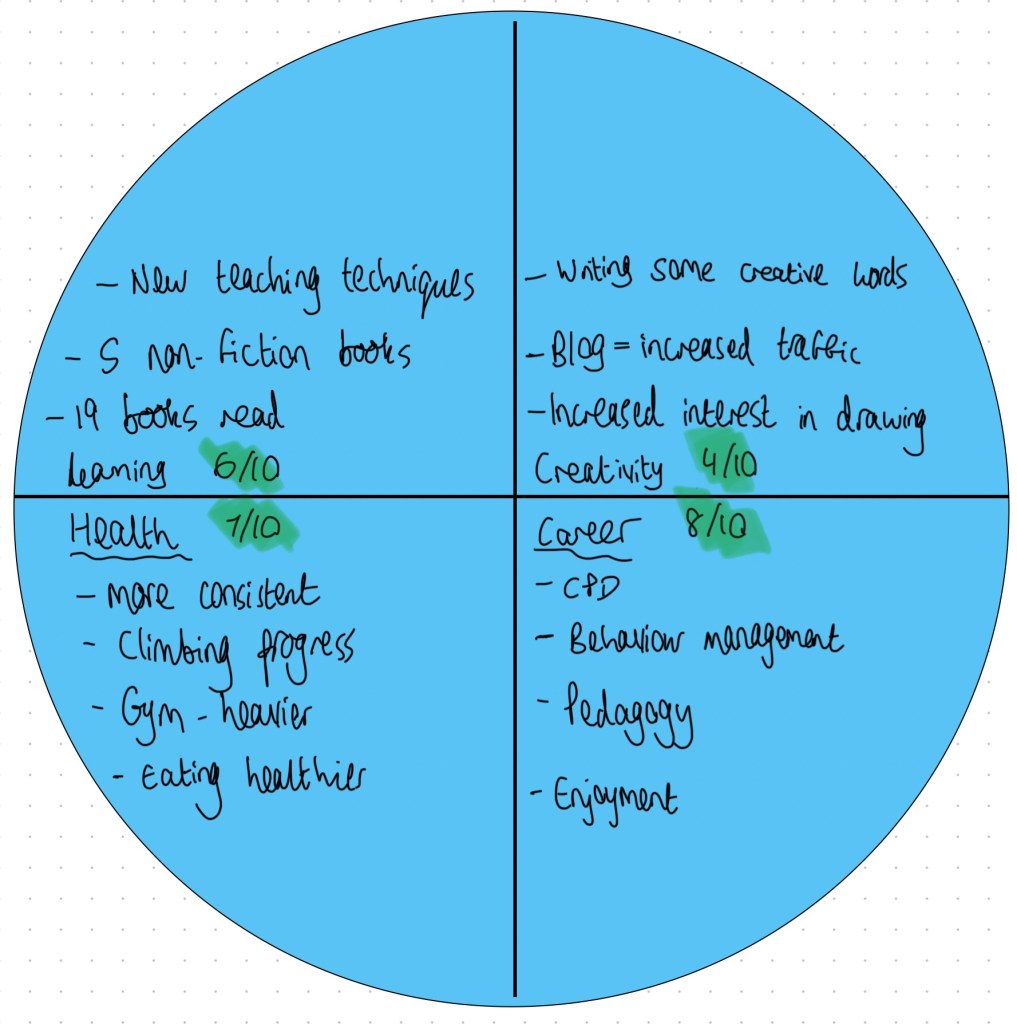
Now that you’ve reflected, it’s time to build a vision. What does your perfect year ahead look like? How much time are you dedicating to work, to personal and professional relationships, and to creative projects? Which areas of those aspects of your life do you want to improve upon? You might find it useful to map out how happy you are with various areas of your life and rate them out of ten, to show yourself, visually, how pleased you are with the amount of time that you spend on various aspects. Give some brief justification for why you’ve assigned each aspect that number.
Personally, I’ve split each area into the Resolutions that I’ve picked for 2025 (we’ll focus on setting meaningful Resolutions next week). I’ve also mapped out my satisfaction career-wise. Then, by the end of the year, I’ll be able to reflect on how much progress I’ve made, and whether any of these numbers have changed.
Here’s how mine looks:
Now we’re ready to focus on how you’re going to improve on these key areas of life.
Setting actionable SMART Goals
Four years ago, I wrote this post on SMART Goals. Unbeknownst to me at the time, I’d got SMART Goals mixed up with the STAR strategy that you’re supposed to use during interviews.
Oops.
Goals must be:
- Specific: What, exactly, are you going to do?
- Measurable: How are you going to know that you’ve done it?
- Achievable: Is your goal feasible? Can you actually take control over it, or is it out of your reach and dependent on others?
- Relevant: Why do you want to achieve this goal? What impact could it have on your life?
- Time-bound: What timeframe are you using to achieve this goal? Will you have nailed it by the end of the year, or is something that fits into your five year plan?
Let’s apply these criteria to my goals to make them SMART:
- I want to be more creative this year. I will use a one-drawing-a-day book to encourage my artistic self-expression, because I enjoyed drawing as a child and want to return to this. I’ll check-in every four months to measure whether I’ve improved as an artist
- I want to continue to work on my health. Therefore, I will park next to our work gym each day and meal prep on the weekends to promote a healthy lifestyle, and keep track of my weight once a week to understand the impact that this lifestyle has on me physically.
- I want to read more. I am going to follow my sleep habits each night, which I’ve outlined in this post, to allow half an hour for reading before bed each night. I will put my phone on charge as a symbol that it is no longer acceptable to doom scroll.
There are a plethora of different ways in which you can break these goals into smaller, more manageable, tasks. Identify some daily or weekly tasks that align with your larger goals, and record these on a to do list or a Bullet Journal. Bullet Journals are especially good because you could use a physical or digital version – check out this post to see what 30 days of digital bullet journaling looks like.
Equally, you could try the Ten Minute Rule, established in the book Indistractible, to help you to focus. If you feel like you’re making progress towards your goals, and then a distraction enters your thoughts, tell yourself that you will be able to do that thing – but only in ten minutes.
Chances are, once you’ve focused for ten minutes, you’ll have entered a deeper state of work, and that distraction will have long since passed.
Finally, why not create an ideal perfect week in Google Calendar? This will show you where, in an ideal week, you want to spend your time – and help you to stick to it.
Building consistent habits
It’s all well and good saying that you’ll make some changes to make this the best year of your life, but what good is that if you don’t build the habits to help you succeed? Building habits is so crucial, since motivation will only take you so far. To be able to go the distance, you need to get yourself used to doing these things over a long period of time; only then will you drive towards long-term results. Simply setting goals (I will draw one thing everyday) is so much less effective than building habits, which includes systems to achieve them (I will always have my notebook on me so that I can draw if I have a spare five minutes).
To build effective habits, you should start small. Focus on only one habit at a time, and build from there, so that these steps are manageable. Then, you could try habit stacking. That’s a method espoused by James Clear’s phenomenal Atomic Habits, which helps you to multitask effectively. It’s where you attach one new habit to an old one, like standing on one leg while you brush your teeth. We have to brush our teeth twice a day, so this is an unavoidable way to improve your balance. See if there’s anything that you can easily habit-stack, such as speed-listening to an audiobook on 2x speed while you do the dishes.
Above all else, you’ll want to stay adaptable when life, inevitably, gets in the way. Chances are that you won’t stick to your new habits every single day, but try not to view that as a setback. Things like these are all part of the process. Don’t view it as a letdown; instead, you’re simply taking one day or night off from your usual routine. Stay flexible and don’t lose sight of the big picture.
2025 is going to be a transformative year. Yes, New Years Resolutions are set in a bit of an arbitrary way (what’s stopping you from making a change in March or April?), but I actually think that they’re a really powerful excuse to improve your quality of life. To build those New Year’s Resolutions – and to ensure that they’re stuck to throughout the year – stay pinned to the blog.
For now, start today by writing down one goal for 2025, and one habit to support it. You hold the power to make 2025 the best year yet.
While you’re here, why not read…
- Reclaim your evenings: A Busy Teacher’s Guide to Healthy Meal prep
- 16 incredible books to read in 2026
- How to actually achieve your goals in 2026: The Anti-Resolution toolkit
- The First 90 Days: How to survive (and thrive) as a new Head of History
- 7 Brutal Questions to Course-Correct your Life before 2026
Keep your eyes glued to my socials:
 Hardly Hamilton
3 thoughts on “How to Make 2025 the Best Year of Your Life: 3 Steps to Transform Your Year”